How to Complete Thailand Digital Arrival Card (Step-by-Step Guide)

By globedrifters Thailand

What is the Thailand Digital Arrival Card (TDAC)?

The Thailand Digital Arrival Card is an online form that replaces the traditional paper arrival card, simplifying the entry process for travelers arriving by air, land, or sea. The digital system helps improve border security, speeds up immigration procedures, and supports public health monitoring, providing a smoother experience for visitors to Thailand.

IMPORTANT: The Thailand Digital Arrival Card is not a visa! Many travelers do not need a visa to visit Thailand. If you are unsure about whether or not you need a visa to enter and travel within Thailand, it’s best to check with your nearest Thai Embassy or Consulate!

Who needs to complete it?

All travelers who are not Thai citizens must fill out the TDAC online before entering the country. This requirement applies to international visitors arriving by air, land, or sea.

When should you fill it out?

Travelers should submit the Thailand Digital Arrival Card online within 72 hours (3 days) before their scheduled arrival in Thailand. Completing the form in advance helps ensure a smooth immigration process and allows authorities to efficiently process your entry information.

What do I need?

To fill out the TDAC, you’ll need the following:

  • A valid passport
  • Your personal information
  • Your arrival details (i.e. flight information)
  • Accommodation details
  • Your health information

If you’re on a Globe Drifters trip, we’ll send you the accommodation details approximately 2 weeks before your trip start date via email in the pre-departure notes.


Step-by-step guide to completing the Thailand Digital Arrival Card (TDAC)

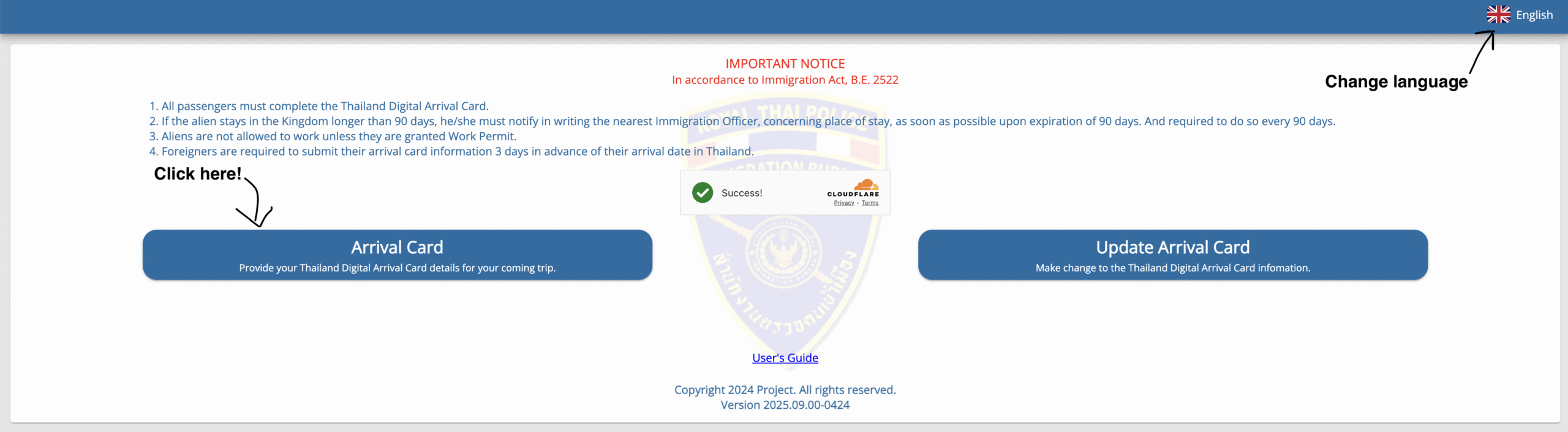
Step 1: Visit the Thailand Digital Arrival Card homepage. Then, click “Arrival Card”. (If you need to change the language, just click the flag icon in the top right corner to select your preferred language.)

Thailand Digital Arrival Card step 1 click arrival card


Step 2: Enter your passport and personal information. It is very important that the information you enter matches that in your passport, wherever applicable! You are only required to fill out fields with a red asterisk* next to them. Click “Continue” when you’ve completed this section.

IMPORTANT: You can only fill out this form within 72 hours of your arrival in Thailand!
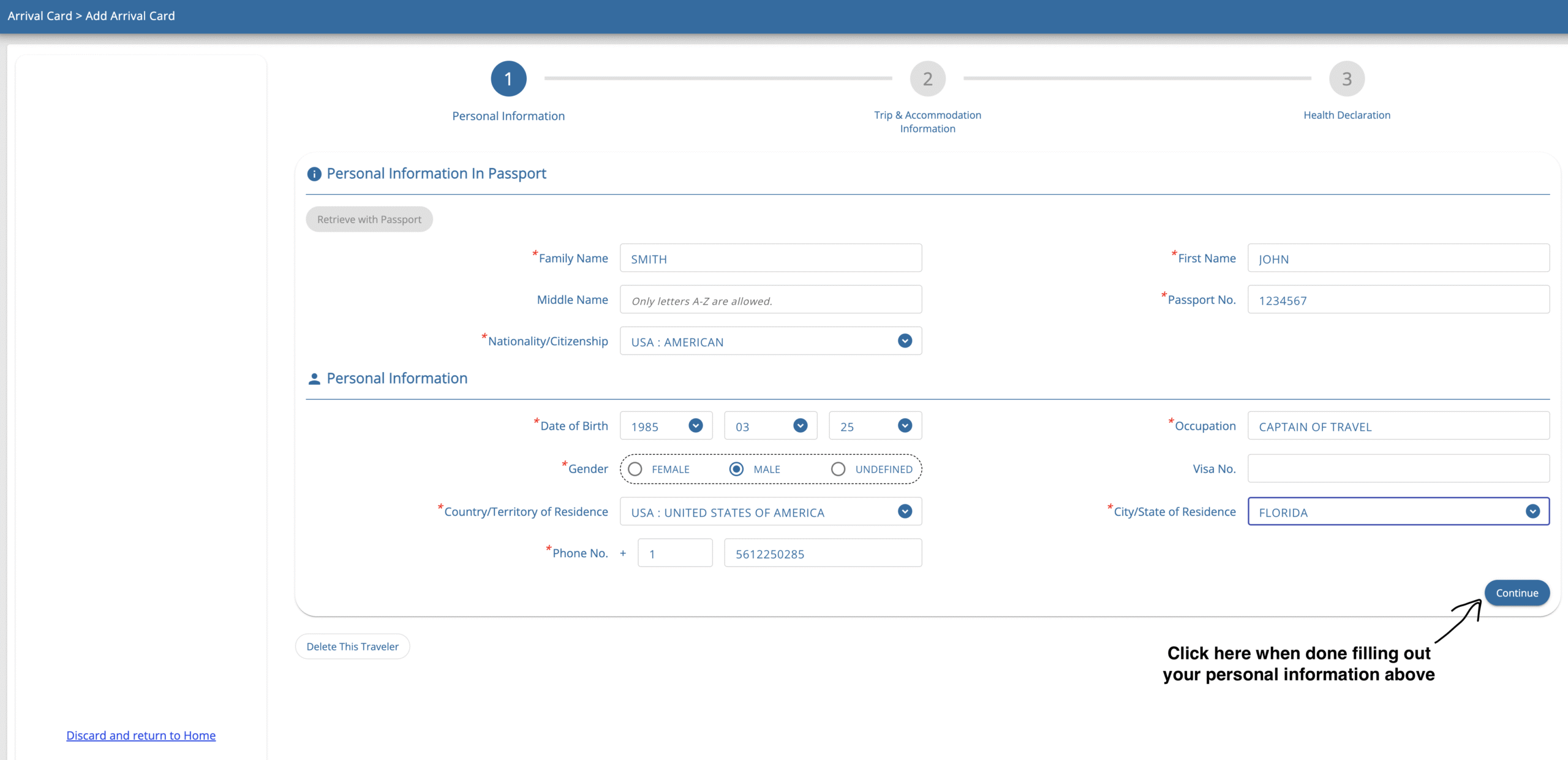
Thailand Digital Arrival Card step 2 personal information


Step 3: Enter your trip and accommodation information. If you are on a Globe Drifters Thailand trip, please refer to your flight itinerary for your arrival/departure information and pre-departure notes for your accommodation information. Once you’ve filled out all required* fields, click “Continue”.

Trip information
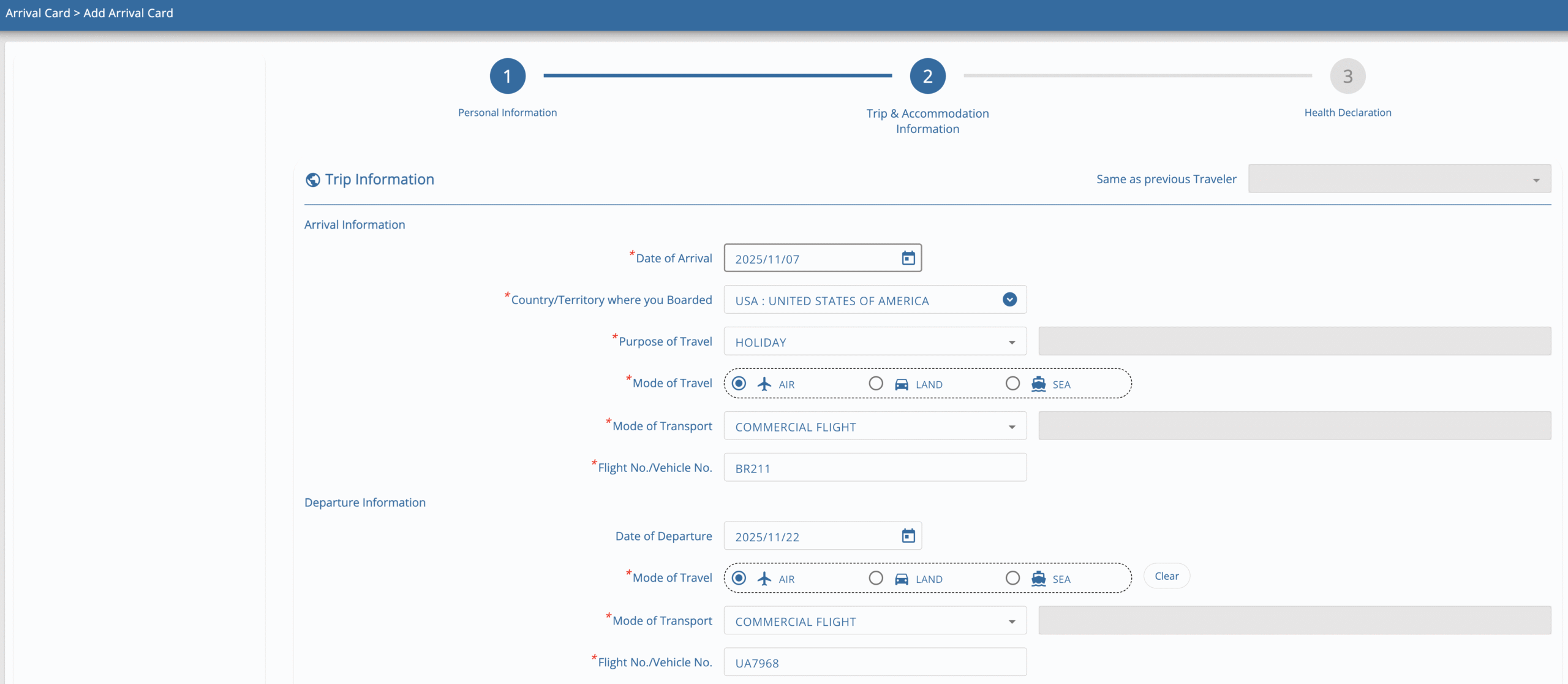
Thailand Digital Arrival Card step 3 trip information

Accommodation information
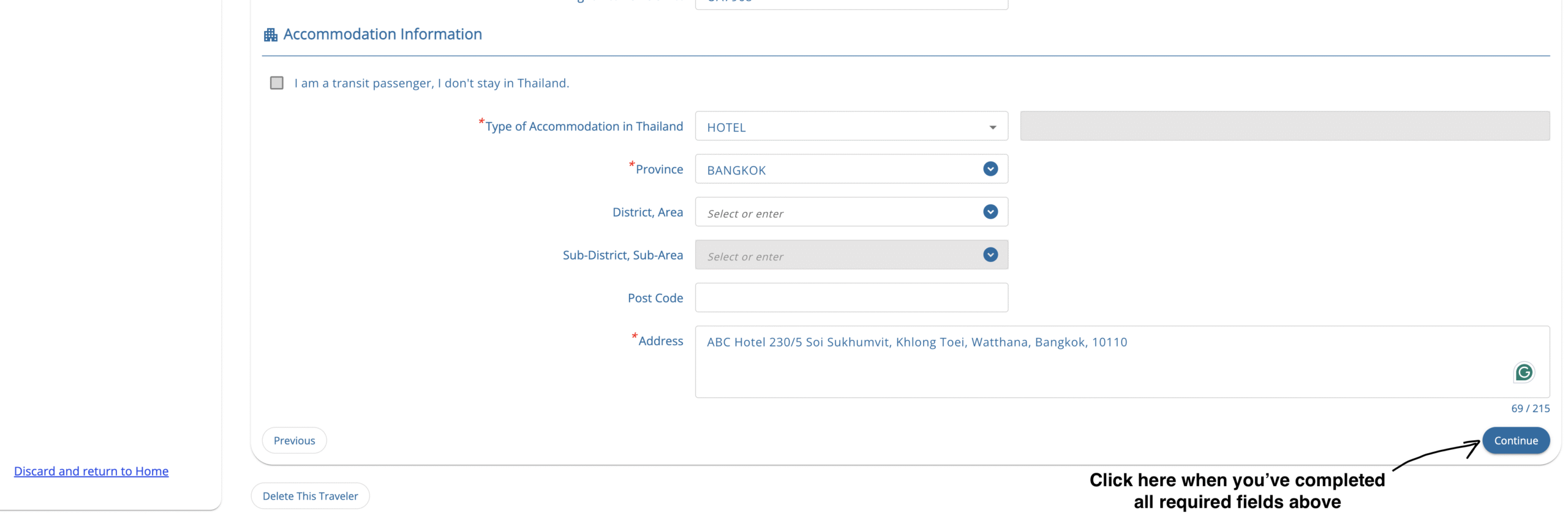
Thailand Digital Arrival Card step 3 accommodation information


Step 4: Enter your health information. Select the country/countries you have stayed in within 2 weeks before arrival in Thailand. Click “Preview”.

Thailand Digital Arrival Card step 4 health information


Step 5: Review the information you entered. Make sure all is correct and matches your passport and flight reservation. Enter your email address. Check the box indicating you’ve read and accepted the terms and conditions. Click “Submit”.
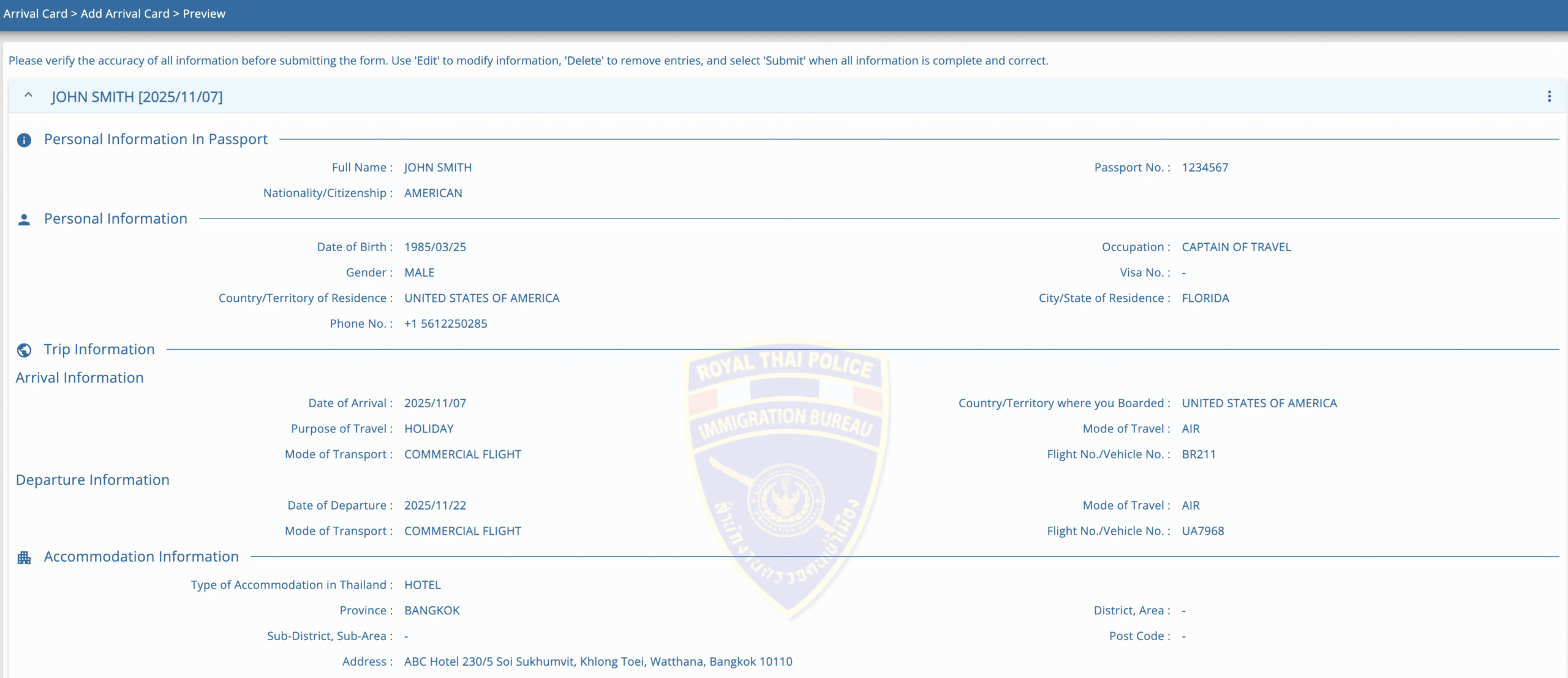

Thailand Digital Arrival Card step 5 review information


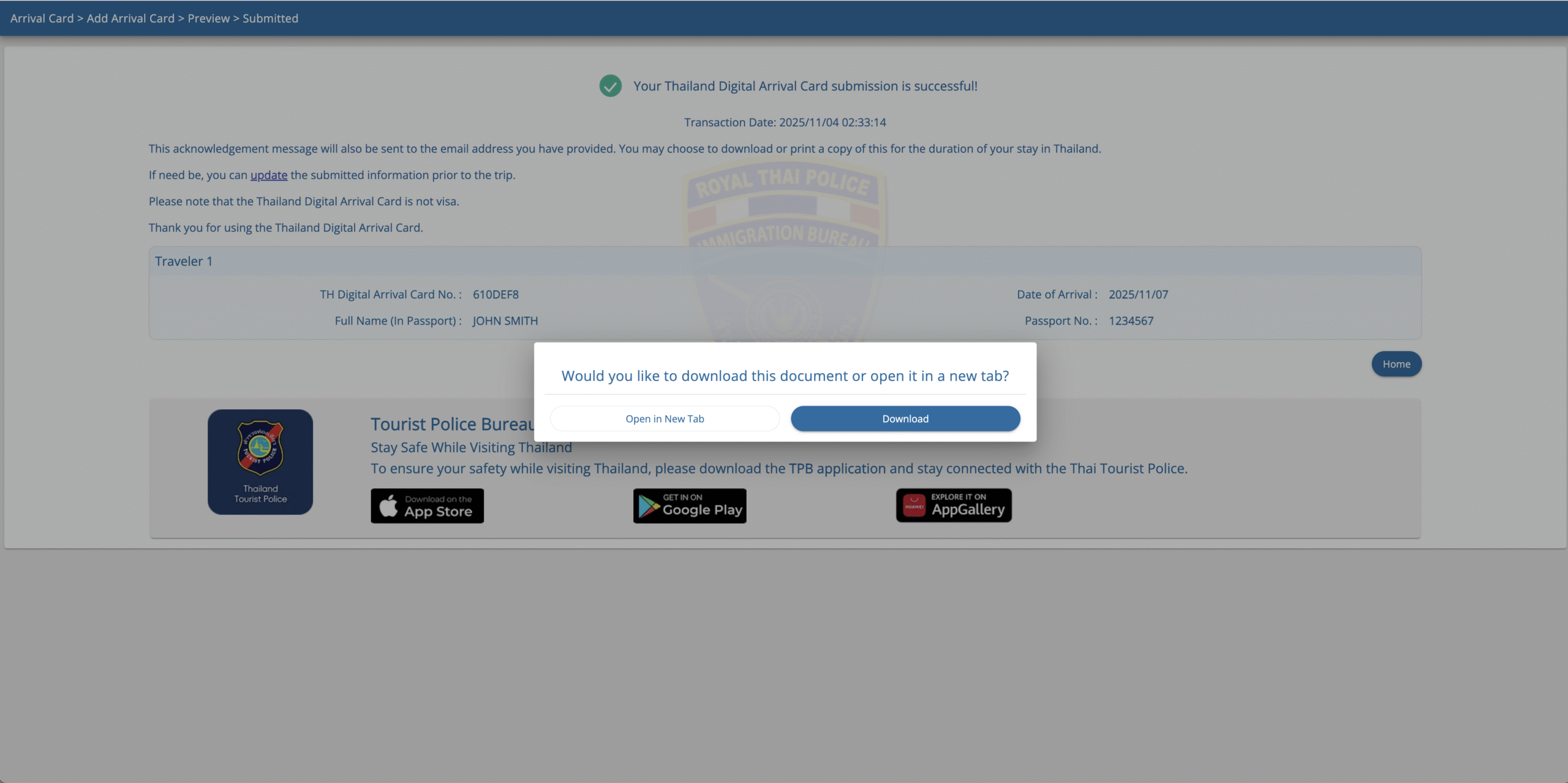
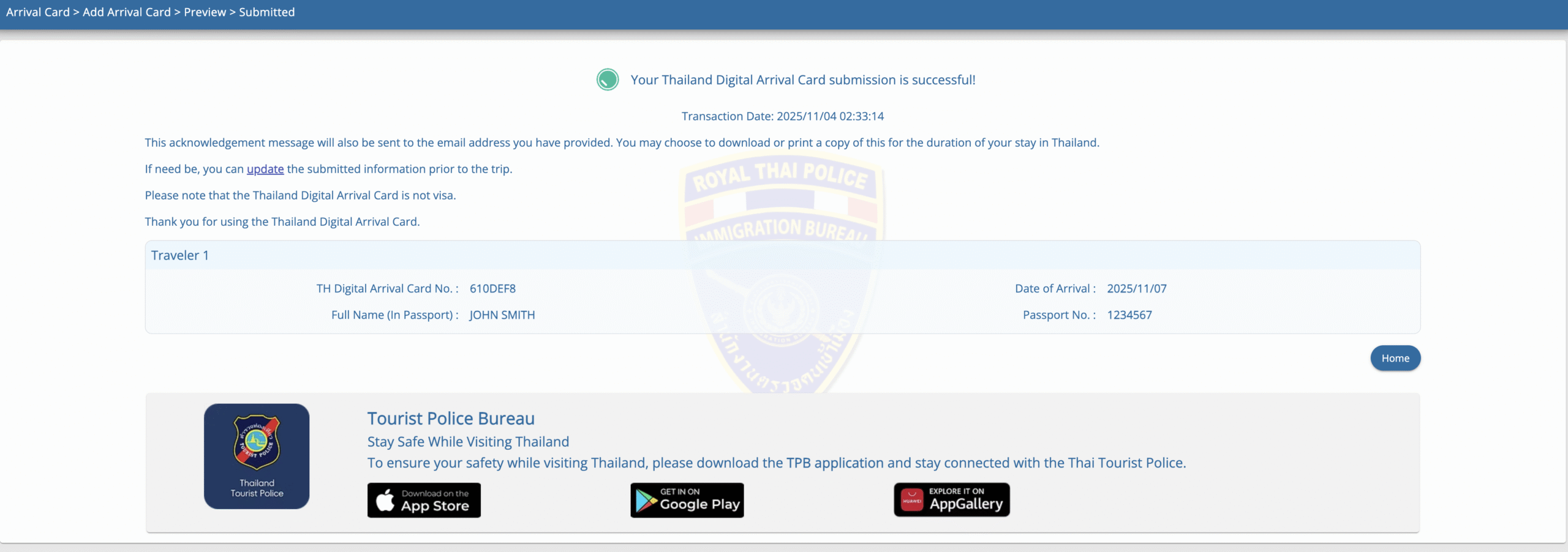
Step 6: Confirm your email address and download your Thailand Digital Arrival Card. 
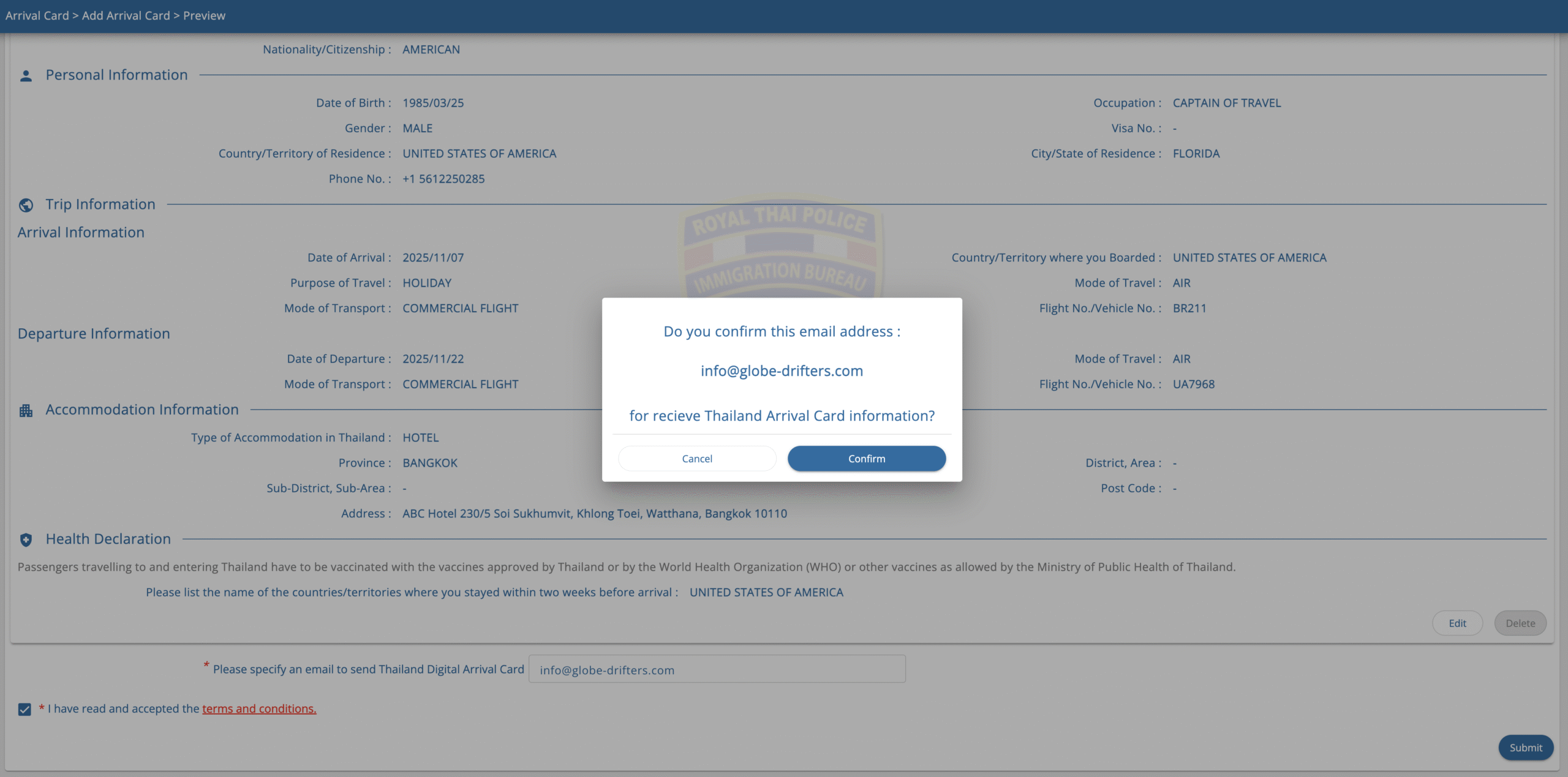
Thailand Digital Arrival Card step 6 confirm Thailand Digital Arrival Card step 6 download document Thailand Digital Arrival Card step 6 form completed


Step 7: Check your email. You will receive an email with the subject line “Thailand Digital Arrival Card Submission”. If you don’t see it in your inbox, check your spam/other folders. This email will have an attachment, which you should save a copy of to your phone and have it on hand when you arrive in Thailand. You should have it ready for when you pass through immigration and passport control. We also recommend printing out a paper copy in case you have any issues with your phone on arrival.

Here is the site where you can update your digital arrival card. If you update your arrival card, don’t forget to check your email again and download the updated attachment!
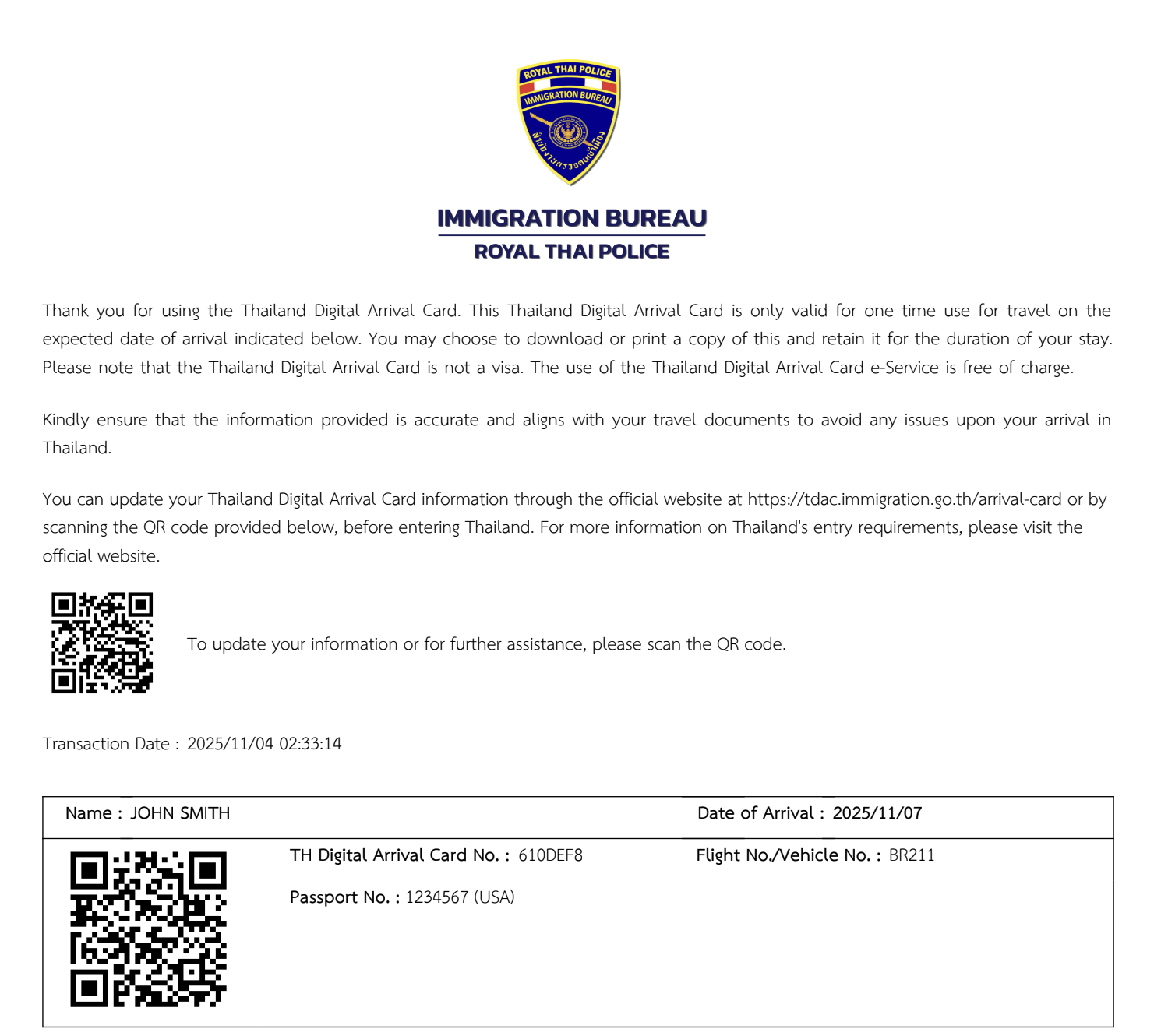
Thailand Digital Arrival Card step 7 check email


By completing your Thailand Digital Arrival Card (TDAC) before your trip, you’ll save time at the airport and enjoy a smoother start to your adventure in the Land of Smiles. Check out our blog about how to get from the Bangkok airport to your hotel in the city if you’d like more information about arrival in Thailand. Happy travels!

getting from bangkok airport 

How to get from Bangkok Airport to your Hotel

By globedrifters Thailand

How to get from Bangkok Airport to your Hotel

Getting from the Bangkok airport to your hotel in the city is easy enough and your best, fastest option is by taxi. There are two airports in Bangkok. One is called Suvarnabhumi Airport (BKK), the international flight hub. The other is Don Mueang Airport (DMK) for domestic flights and some flights to and from neighboring countries. Both airports are about equal distance from the city center of Bangkok. For our 15-day Thailand for Lantern Festival trip you will usually fly into Suvarnabhumi Airport (BKK) and airport pick-up is not included. We’ll help you get your adventure in Thailand started with these 2 ways of getting from Suvarnabhumi Airport (BKK) to your hotel in the city center.


Arriving at Hanoi Suvarnabhumi Airport (BKK)

To get started, you’ll need to deplane and go through immigration. Look for the signs that say “Immigration” and they will point you in the right direction.

Follow the “Immigration” signs.

Pass through immigration

Follow the “Foreign passport” signs and be prepared to wait as there are usually a lot of people standing in line. The lines typically move relatively quickly but you could be there for a while.


Follow the “Foreign passport” immigration lines.

Collect your luggage and exchange/withdraw money

After passing through immigration, make your way to the baggage claim area. Take a look at the monitors to find your flight number to see what baggage claim carousel your luggage can be found at.

Once you collect your bags, you may want to exchange some money at the exchange counter. These counters are located generously outside of the baggage claim area.

You can exchange money after exiting the baggage claim area.

Remember that the airport currency exchange counters do not usually offer very good exchange rates. We recommend exchanging a small amount of cash, around $50 USD or so. Alternatively, you might select to withdraw cash from the ATM. Even if withdrawing from an ATM, it’s a good idea to bring some cash to exchange just in case your bank puts a stop on your card. If pulling from an ATM, we suggest taking out a relatively larger amount as withdrawal fees are usually 220 baht ($6) per withdrawal plus whatever fees your home bank charges you, usually around $5 per transaction. We suggest pulling out the maximum, usually 20,000 baht (approximately $565 USD), depending on the machine.

Thai baht (THB).

Now, you’re ready to catch your transportation and start your adventure in Bangkok!


Option 1: Pre-booked airport pick-up

One way to get from the Suvarnabhumi Airport (BKK) to your hotel in the city center is to pre-book airport pick-up before arrival with a transport company such as Welcome Pickups. This is one of the slightly faster and more expensive options. It will take you approximately 45 minutes to an hour to get to the city center. You can find other transfer companies by searching travel websites such as TripAdvisor. The cost will vary depending on the company.

If you’ve pre-booked your airport pick-up, you’ll usually find a driver waiting for you after luggage claim in the public arrivals area. He’ll typically have a sign with your name on it. It’s best to ask your transfer company for specific instructions and what/who to look for.

For those on the 15-day Thailand for Lantern Festival trip, we will put you in touch with one another before the trip starts so you can share flight arrival times and coordinate pre-booked airport pick-up if you so wish.

It’s important to have WhatsApp downloaded and set up on your phone before you arrive so you can be in touch with the transfer company and/or driver. There is free Wifi at the Suvarnabhumi Airport but if you can’t connect, you can turn on data roaming.

*IMPORTANT: Globe Drifters does not vouch for any transfer companies you may find online. It’s important to do your research, read reviews, and contact the company to make sure that it is indeed a trustworthy, legitimate company.


Option 2: Take a taxi

Find the public taxi computer kiosks

One of our favorite things about Bangkok airport is there is almost zero or very limited harassment from taxi drivers like you may have seen in other airports around the world. This means you won’t be swarmed by taxi drivers trying to make a quick buck as soon as you step outside. All you need to do is follow the “Public Taxi” signs to catch your ride to your hotel.

Follow the “Public Taxi” signs.

Go down one floor and continue following the signs that say “Public Taxi” (see below).

Keep following the “Public Taxi” signs!

You will eventually arrive at a line of public taxis. You will also find some small computer kiosks there. There are usually two attendants standing by if you need help. Watch the video below to help you find the public taxi kiosks.

Push the only button in the middle of the computer screen and you will receive a number between 1 and 25. Locate the illuminated lane number that corresponds with your ticket and go to the car in that lane.

Look at your ticket # and find the corresponding taxi lane.

The taxi driver will help you with your luggage. These are all metered taxis so don’t worry about getting ripped off.

Give the driver the name of your hotel and the address written in Thai from the pre-departure notes and you’ll be on your way!

Taking the highway and paying the tolls

Your taxi driver may ask if you want to take the ‘highway/toll’. The answer is yes! The highway/toll road has much less traffic and is considerably quicker. You will arrive at the first toll and it will cost 25 baht (approximately $0.75 USD). The taxi driver will usually ask you for the money for the toll. The toll roads provide change so don’t worry about only having large bills. The driver might give you back all of your change or keep 50 baht from the change as there will be another toll to pay in about 5 minutes which costs 50 baht (approximately $1.50 USD) to pass through. He will more than likely just ask for 75 baht at the first toll and use the leftovers to pay for the 2nd toll. In any case, the total amount for the two tolls is 75 baht (approximately $2.00 USD).

This is what one of the toll booths looks like.

Below you can see toll receipt tickets that you’ll receive: One for 25 baht and the other for 50 baht. The total for all toll roads comes to 75 baht.

You will need to pay 2 tolls, one for 25 baht and another for 50 baht.

Once you arrive at the hotel, you will pay the amount on the meter plus 45 baht for the airport surcharge. The driver might ask you for a tip and 50 baht is sufficient. The most common way to tip is to just round up your tab. For example, if you owe 445 baht, just give the driver 500 baht.

It takes approximately 45 minutes to an hour to get to the hotel depending on the traffic. The cost of the taxi is usually around 350 ~ 500 THB.


Both options above have their pros and cons and the 2 mentioned above have worked in the past for our travelers. You may find another option that works better for you. If you’re on one of our Thailand trips, get settled, relax at the hotel’s pool, or ​​explore the surroundings as the hotel is centrally located. Happy travels!
 

Festivals in Asia Worth Planning Your Trip Around

By globedrifters Thailand

After living and traveling in Asia for many years, I’ve learned one thing: this part of the world loves festivals. There’s a full moon festival, a harvest festival, the washing hair festival, a camel festival, a weaving festival—the list goes on. Many are fun, but what festivals are worth planning your trip around?


Loy Krathong Festival: Thailand’s Festival of Lights

Let’s start in Thailand with one of the most beautiful festivals in Asia: Loy Krathong. Known as the “festival of lights,” it takes place every November under the full moon of the twelfth lunar month. The name “krathong” means a small basket made from banana leaves. During this festival, people fill the basket with flowers, incense, and candles before setting it afloat on rivers, bays, or canals.

Once you set your basket adrift you make a wish and some people believe that the longer your candle stays lit the more likely your wish will come to fruition.

The candle also signifies longevity and the washing away of sins. The sight of thousands of glowing krathongs floating on the water is pure magic. Some even look like ice cream cones! People write wishes on them, hoping the lantern flies high and doesn’t burn out—a sign that their wish will come true.

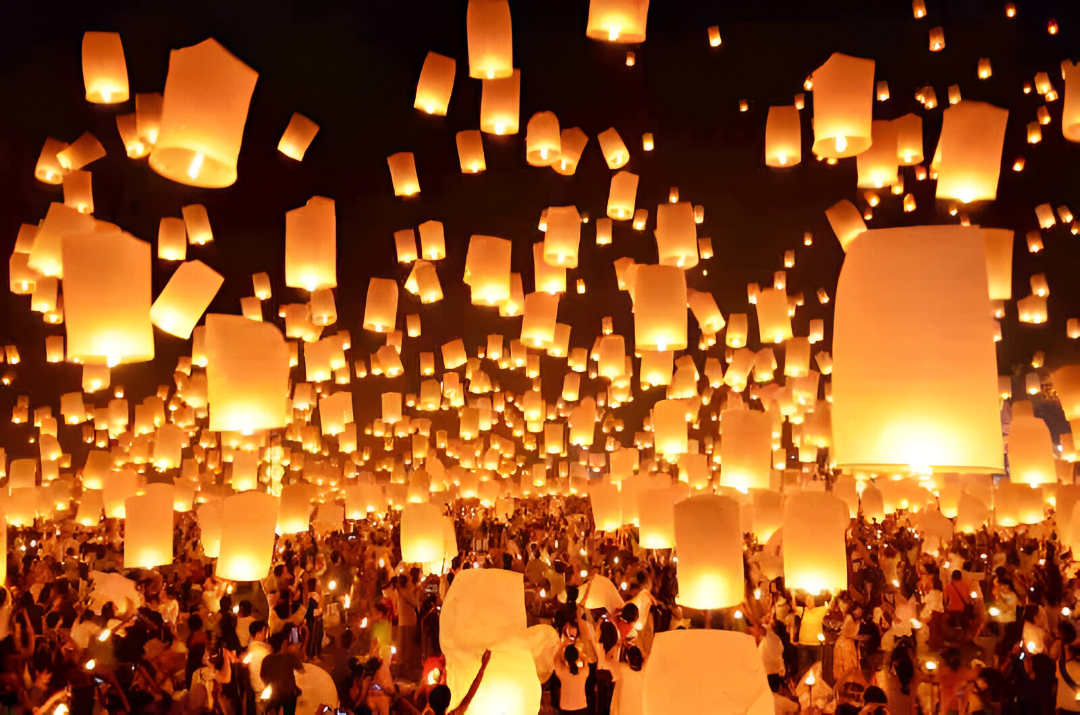
You’ll also spot floating lanterns in balloon form drifting into the sky. People write their wishes on them, hoping the flame doesn’t go out—another good omen. We once wrote our company name on one of those lanterns, and guess what? It stayed up. So maybe it works! 😄

The tradition has carried to the west and you see many of these lantern balloons at weddings and parties. While Loy Krathong is celebrated throughout Thailand, one of the most magical places to experience it is in Chiang Mai. If you’re curious to see more, you can check out our pictures from our last trips to Thailand for the Loy Krathong festival.


Songkran Festival: Thailand’s Ultimate Water Fight

Ever wanted to throw buckets of water at strangers or roam around with a Super Soaker? Here’s your chance! Songkran is one of the wildest festivals in Asia, marking the Thai New Year every April.

Traditionally, Songkran involved pouring scented water over Buddha statues and gently sprinkling elders as a sign of respect. People cleaned their homes and made New Year’s resolutions.

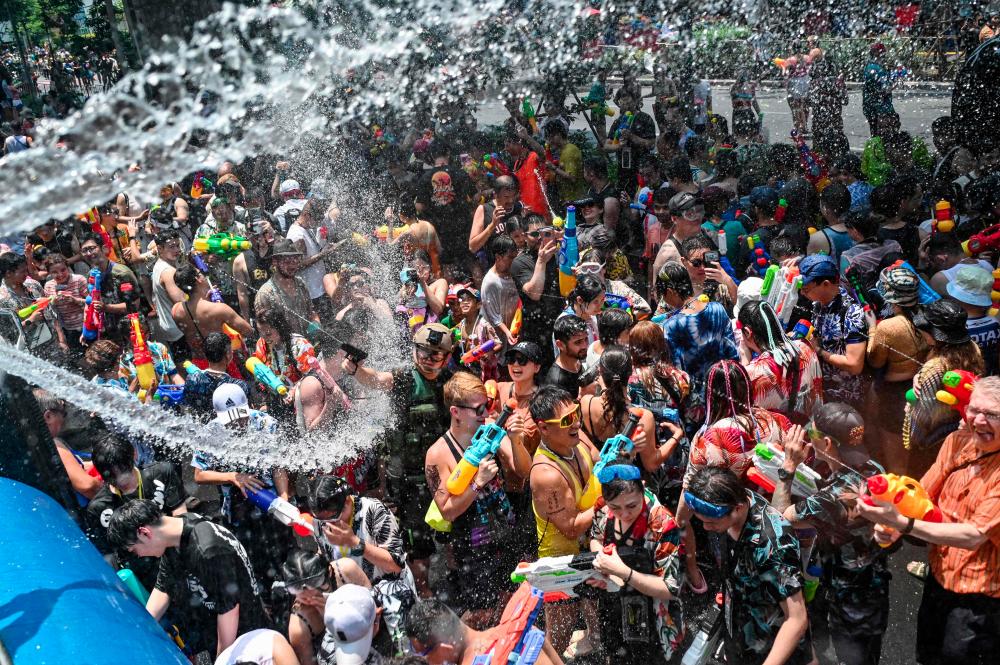
These days, Songkran has evolved into a three-day nationwide water fight. Buckets, water guns, icy water—even elephants—are fair game. Locals and tourists alike join in, especially since April is one of Thailand’s hottest months, with temps often soaring above 100º F.

Of course, there are rules. Monks and pregnant women are off-limits. You do not splash water in restaurants, hotels, or people’s homes. And after sunset, the city calls a ceasefire so people can change into dry clothes.

Songkran used to be celebrated only in Northern Thailand, but now it’s nationwide. Similar festivals in Asia happen around the same time in Laos, Cambodia, Myanmar, and China’s Yunnan province.

If you want to find out the dates of Songkran, check out Thailand’s official tourism website for more info and tips.


Holi Festival: India’s Festival of Colors and Love

Across the way in India, you’ll find one of the most famous festivals in Asia: Holi, the vibrant “festival of colors.” It’s celebrated each March and has become so popular that many Western cities now host their own versions.

The origins of Holi differ by region. In one legend, an evil king forced people to worship him. His son, loyal to Lord Vishnu, was punished for defying his father. The king’s sister, Holika, tricked the son into sitting with her on a pyre, thinking her protective cloak would shield her from flames. Instead, the cloak flew to the boy, saving him while Holika perished—symbolizing the triumph of good over evil. Many kick off Holi with a bonfire called Holika Dahan.

Another story links Holi to Lord Krishna, who feared women wouldn’t love him because of his blue skin. His mother suggested he color the face of a girl he liked—Radha. It worked, and they fell in love. Today, Holi celebrates love, forgiveness, and fresh starts.

Although Holi is a Hindu festival, people of all faiths in India come out to hurl colors and water at each other. But be warned—it gets rowdy fast. Local men often drink bhang (a cannabis drink), making the crowds wilder. Women travelers should join the fun early in the day before things get too raucous.

For more pictures about Holi, check out the pictures from our last trips to India during Holi.


Pushkar Camel Fair: A Spectacle in India’s Desert

The Pushkar Camel fair in India is one of India’s most highly-rated travel experiences. It’s a spectacle on an epic scale that draws over 400,000 people and 11,000 camels, horses, and cattle for nearly 2 weeks in November.

The Pushkar Camel Fair feels like a step back in time. Traders set up desert tents and barter over livestock. Men show off elaborately decorated camels, compete in races, and even vie for the longest moustache. Meanwhile, women set up stalls filled with jewelry, textiles, and traditional crafts, while dance and music fill the air.

There are all kinds of competitions during the festival. You’ll see contests for the camel with the most intricate decorations, thrilling camel races, and even a longest-moustache competition! Locals and foreigners alike can place bets—or jump in and play in a lively game of cricket alongside the crowd.

It’s a time when men proudly show off their prized livestock and the skills of their camels, while women set up colorful stalls brimming with bracelets, clothes, and textiles, and join in vibrant dance performances.

The fair takes place every November during the Kartik Purnima full moon. For visitors, it’s a once-in-a-lifetime chance to experience the color, chaos, and carnival atmosphere of one of the last great traditional trading festivals—where livestock, farmers, traders, and villagers gather from all across Rajasthan.


If you travel in Asia long enough, you’re bound to stumble into one of these festivals in Asia—sometimes without even trying. Whether it’s floating lanterns in Thailand or camels in the desert, these celebrations offer glimpses into local life and culture that you just can’t get anywhere else.

So what about you? Have you been to any festivals that completely blew your mind? Drop a comment below—we’d love to hear your stories! Happy travels!
thailand travel tips 

Phu Chi Fa, Thailand

By globedrifters Thailand

Phu Chi Fa, Thailand

Phu Chi Fa is located in the Northeast of Thailand and is rarely visited by foreign tourists but is a popular vacation spot for local Thai’s.  Most locals in Thailand cannot afford a vacation overseas but going to Phi Chi Fa is almost like going to a new country for locals.

Many Thai’s have never experienced cold weather nor have they seen a mountain range so many locals come here to get their first dose of both of these things and they usually camp inside the national park.  Their excitement is clearly seen where they wrap a scarf around their neck and put on mittens for the first time, although most did not invest in closed toed shoes as they walk around in flip flops with socks underneath.

The main attraction here is going to the peak of the mountain to watch the sunrise.  This sounds like a treacherous hike but it is not.  In the morning their are minivans that will take you into the national park and to the base; from there you only have a 20-30 minute hike in front of you.  The hike has a moderate incline on a wide dirt path with plenty of places to pull to the side and take a rest if feeling tired.  I saw kids as young as 5 and as old as 70 going up so don’t worry, it is accessible for most.  You will need a flashlight but there are many vendors selling flashlights at the base of the hike in case you forget.

At the top of the mountain expect to see a crowd although if you go in the summer months you might just see a few monks with no one else around. Normally the crowd would annoy me but it is fun seeing all the Thai people so excited to be in cold weather and lets face it, we foreigners have inundated their country so we can’t hate.   The picture below does look crowded but the summit is large enough that you can find a spot to sit down and wait in the dark and once the sun starts to rise everyone stands up to take pictures and it is not an issue finding a spot with an unobstructed view.

Although, it is an early start it is well worth the early wake up call as you the sea of clouds and mist envelop the mountains.

Since it is very early in the morning and you will be sitting around for 30 minutes to an hour waiting for the sunrise it is best to have a jacket, pants and closed toed shoes.  When I went it was maybe 40 degrees Fahrenheit.

Most locals and foreigners alike embark to Phi Chi Fa from the northern city of Chiang Rai but if you are up for more of an adventure you can take a scooter or motorcycle here.  Actually, you will see a lot of motorcycle tours go through this town as this is almost always a stop on their tour and if interested we do a 10-day scooter tour and stop here as well. The below picture are what the roads look like.

If you would rather not brave the roads of Thailand there are minivans from Chiang Rai that take you to Phu Chi Fa and they run daily although you will have to leave around 3:30 AM to get there in time for the sunrise.

If you do decide to stay the night it is quite difficult to pre-reserve accommodation as most of the hotels accommodate the large Thai groups therefore they do not offer their hotels on booking sights because they get enough business from the locals. Also, there is no information in English online about accommodation here with limited English spoken by most of the staff so if you have a Thai friend to help you book that would be ideal.   There are a lot of places to choose from so it is not necessary to have a reservation but it is recommended in the peak season (December – February).

use29

p.txt-1

IMG_4401

Phu-Chi-Fa-001

IMG_4407

IMG_4417

IMG_4416

24867500940_e9bc646aae_b

IMG_4586

rolling hills


Khao Sok National Park, Thailand

By globedrifters Thailand

Khao Sok National Park, Thailand

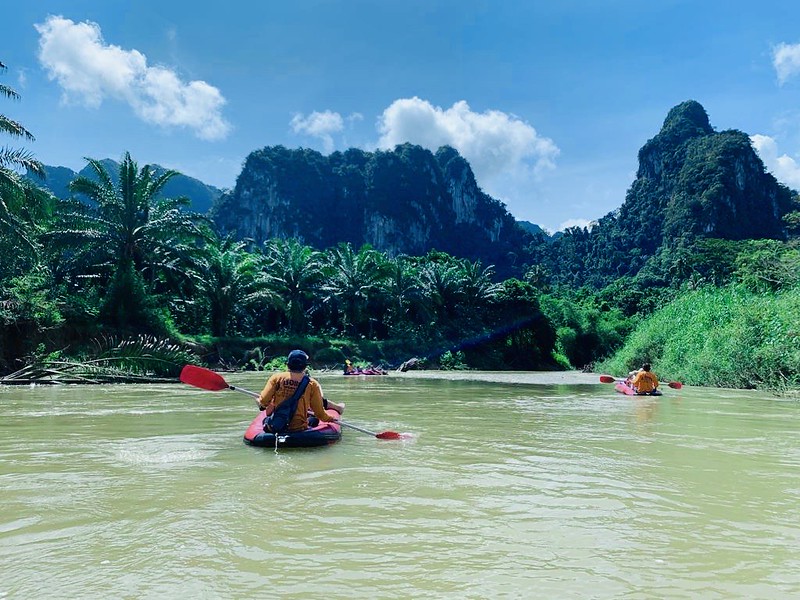
Khao Sok is not really ‘off the beaten path’ per say but it is skipped over quite a bit on people’s trips to Thailand. Khao Sok is in close proximity to both the islands in the south and in the east, approximately 2 hour drive.

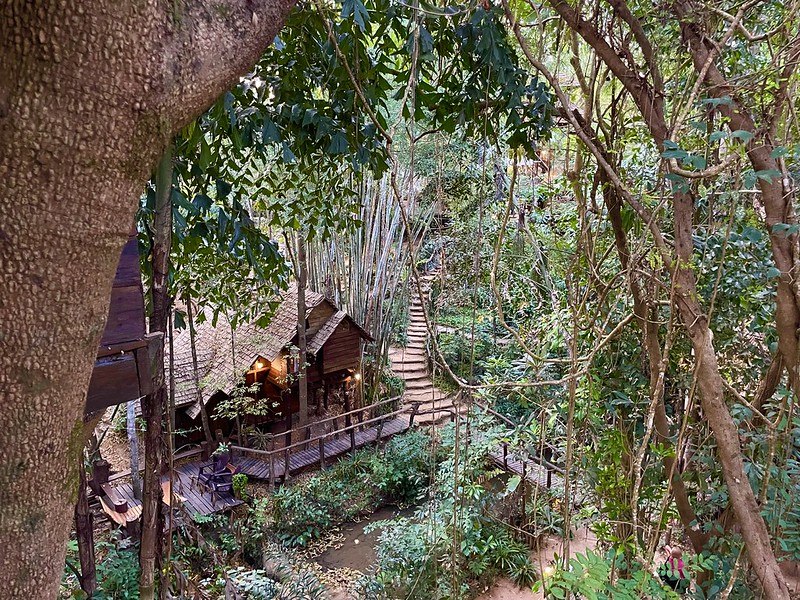
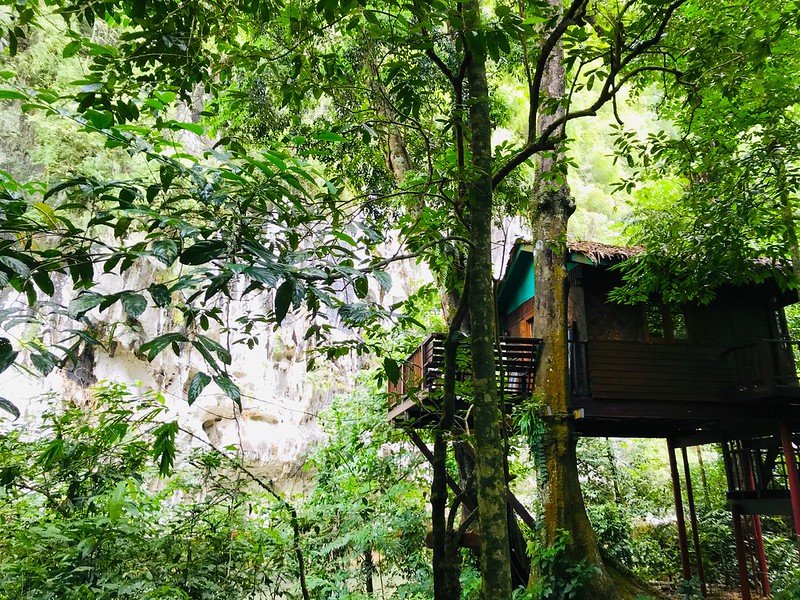
My favorite accommodation in Khao Sok is at ‘Our Jungle House’ and was one of the very first eco hotels before ‘eco’ was even a thing.  We stay here on our tour and many have said it is one of their favorite stops on the trip!

Khao Sok is one of the oldest jungles in the world and is said to be over 160 million years old which would make it the second oldest jungle in the world.

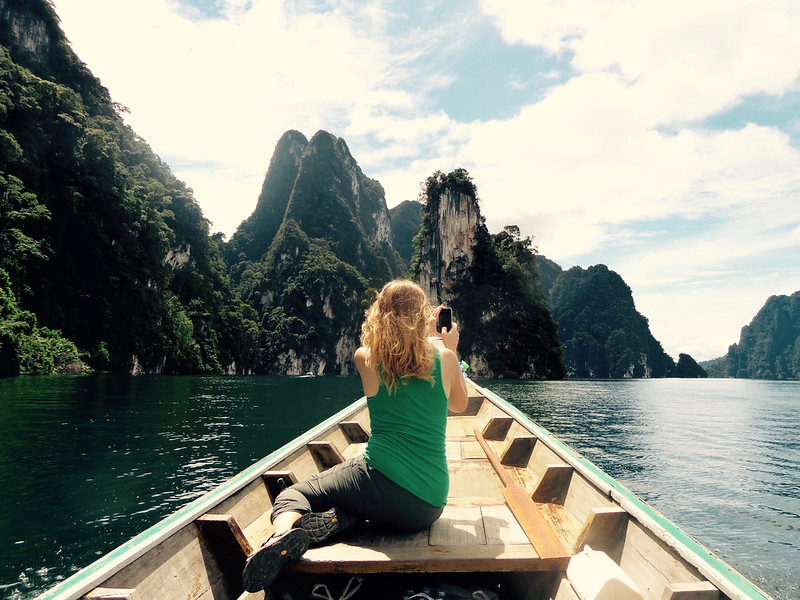
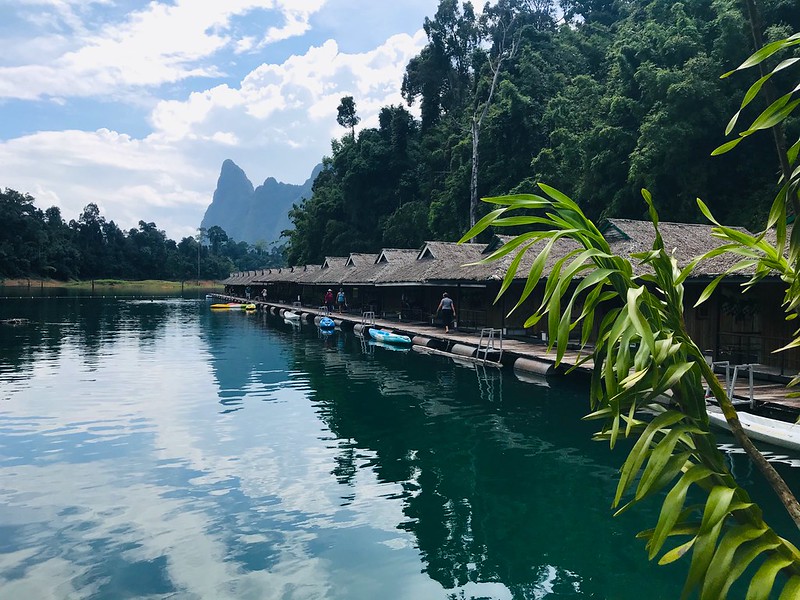
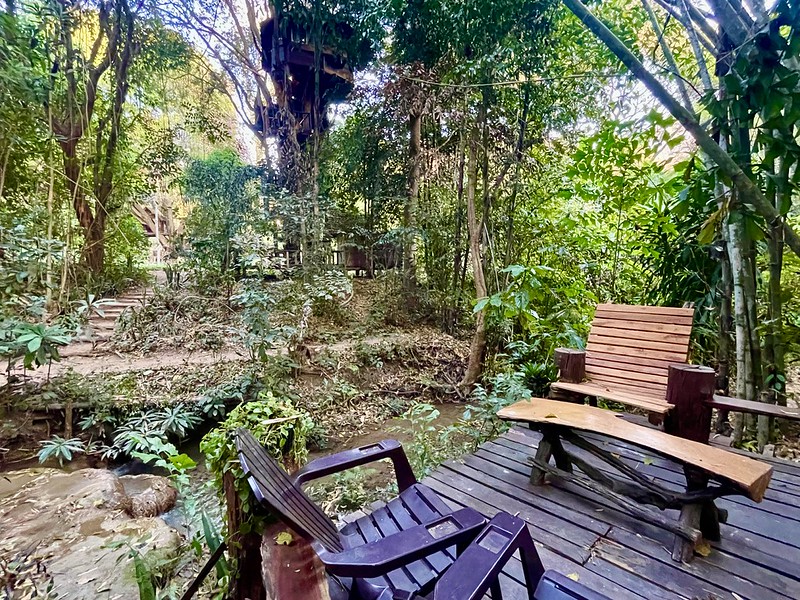
One of the highlights of the park is staying inside the national park on floating lake houses.  

Although the lake houses lack a bit in comfort the views make up for that and is a bit reminiscent of camping.

Khao Sok is one of my favorite places ever and the rainforest is absolutely amazing! Other activities you can do is go tubing, canoeing, hot springs, night jungle treks and so much more. 
DSC05721 copy

81 copy

78 copy
26 copy

100 copy

24 copy

23 copy

124 copy

19 copy

126 copy

travel tips globe drifters 

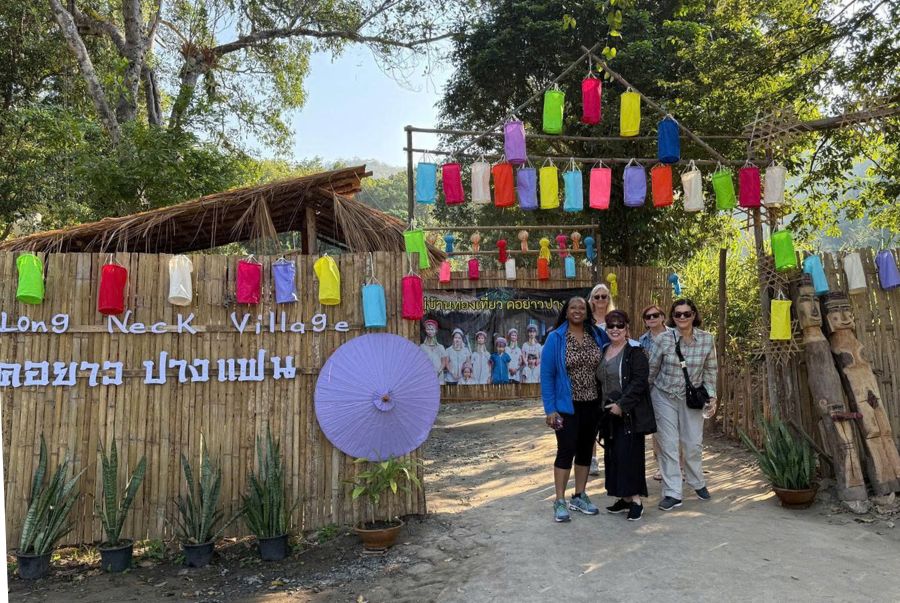
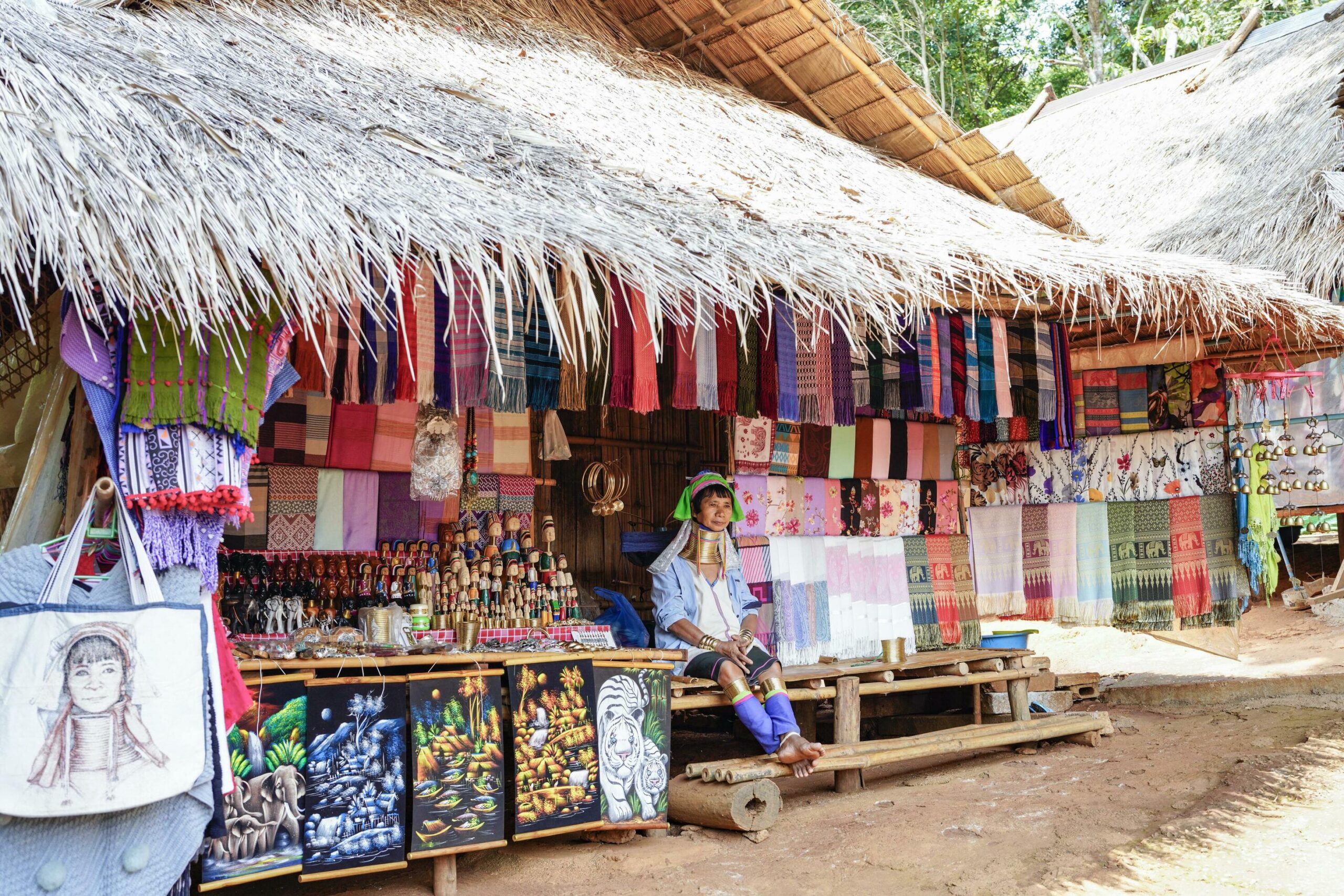
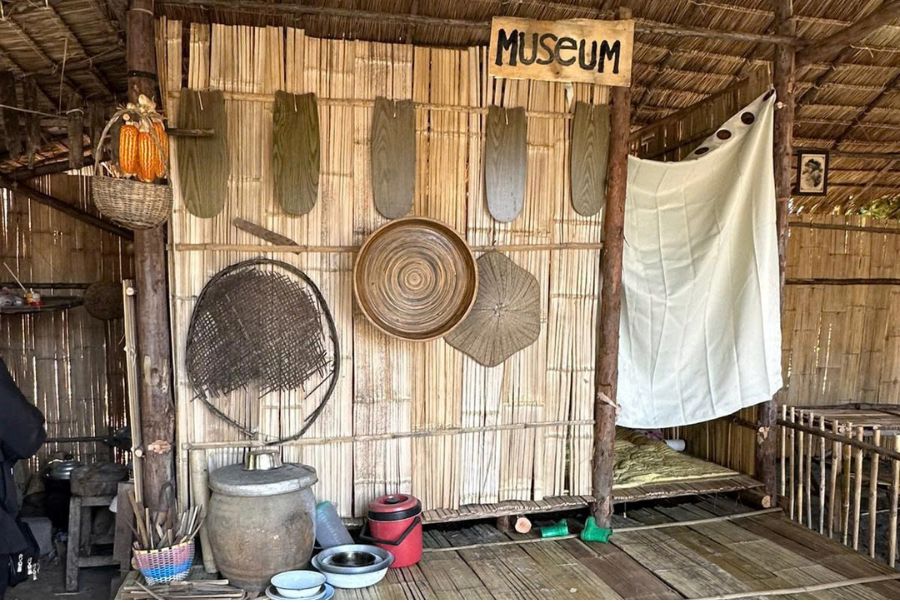
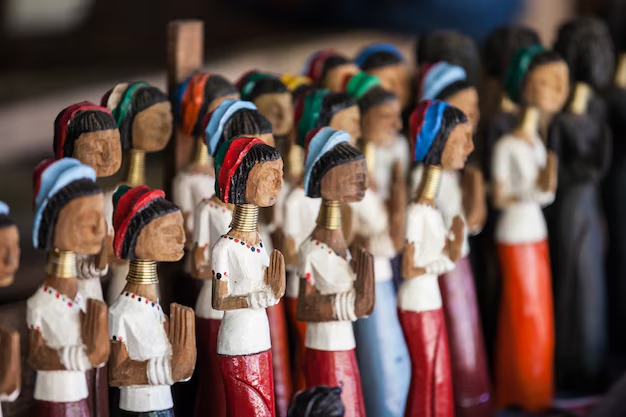
Long Neck Village – Ethical Issues

By globedrifters Myanmar | Thailand

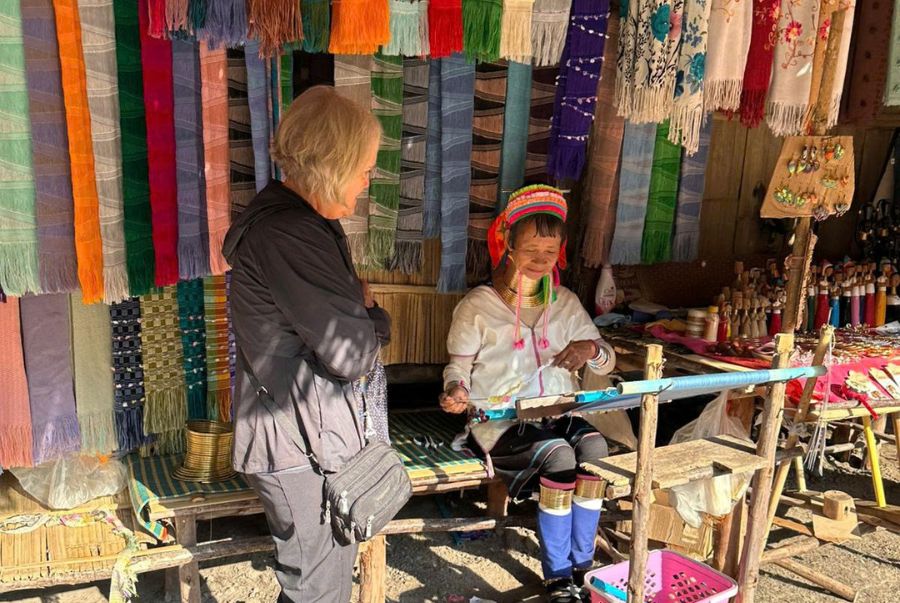
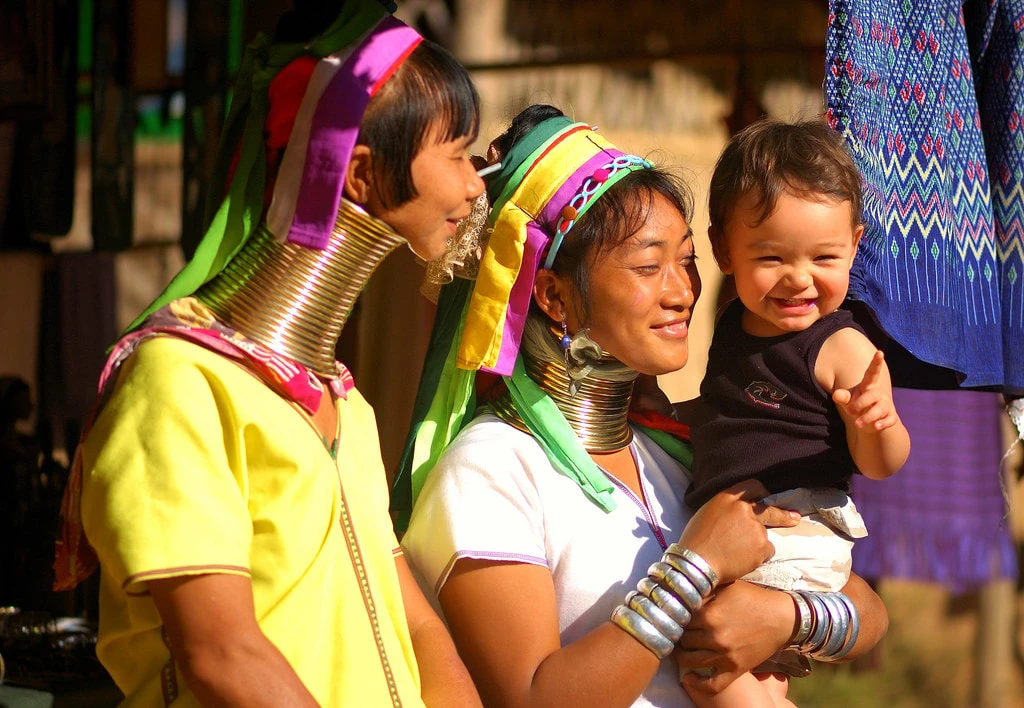
Ethical issues when traveling to Southeast Asia has always been at the forefront of traveler’s minds. Are we hindering or helping child beggars by giving them money? If we ride on an elephant are we exploiting them? If we visit a ‘long neck’ village, are we encouraging the cultural torture to continue?

Don’t get me wrong, in the West we are burdened by many ethical problems of our own but when you go to South East Asia many of these moral dilemmas are brought upon by tourism and we see it first hand, hence why we feel the need to write about it, talk about it and take action to improve it. But the big dilemma seems to be there is not any clear-cut answer. It is neither black nor white but a large grey area.