1



$5,250 USD – Single occupancy
$4,450 USD – Double occupancy
(See below for occupancy options, inclusions, and exclusions)
A deposit of half the trip cost is needed to secure your spot. The other half is due 75 days before the trip start date.
*$300 of the deposit is a non-refundable booking fee. You can view our cancellation policy HERE.
Credit or debit card payments are subject to processing fees at booking and are non-refundable under any circumstances. To avoid these fees, you can pay via bank account instead.
Single occupancy package –$5,250 USD per person
If you prefer your own room throughout the trip and do not want to share a room, this option is recommended for you.
Roommate pairing package – $4,450 USD per person
If you are traveling solo but are open to sharing a room, we offer roommate pairing with another traveler of the same gender on a first-come, first-served basis. You’ll be introduced to your roommate after booking. IMPORTANT: If a match is not found by 75 days prior to the trip start date, the single occupancy rate will apply.
Double occupancy package – $4,450 USD per person
This option is for two travelers booking together and sharing a room.
Our trips attract thoughtful, open-minded guests from around the world. Group dynamics are part of what makes these experiences so special, so we ask that all travelers treat fellow guests and locals with kindness and respect.
We also believe in flexibility. Travel in Morocco can be beautifully unpredictable — that’s part of the adventure. If you’re someone who can go with the flow, laugh when plans shift, and embrace cultural differences, you’ll thrive. If you tend to focus on small inconveniences or expect everything to feel like home, this may not be the right fit.
Morocco is not like home — and that’s the point. Water pressure, bed firmness, room temperature, and WiFi can vary, especially in more remote areas. Come with curiosity and adaptability, and you’ll be rewarded with an unforgettable experience.
Your local guide is there to guide, support, and enhance your experience — but they are not personal assistants. A degree of independence and self-sufficiency is expected and appreciated.
Our trips are designed for semi-independent travelers. If you choose to skip an included activity, you are responsible for arranging your own plans (though we’re happy to offer recommendations).
If you arrive early or stay later, pre- and post-trip arrangements — including accommodations and transport — are yours to organize, as our support begins and ends with the official trip dates.
This trip requires a low to moderate level of fitness. You should be comfortable being active throughout the day. If you prefer to skip an activity, you’re always welcome to explore independently.
To participate comfortably, you should be able to:
Walk 1–2 miles (1.5–3 km) per day over a mix of surfaces — including sand, uneven paths, and cobblestones.
Be on your feet for up to 4 hours at a time, walking or standing indoors and outdoors in varied weather.
There are usually 2-3 flights of stairs in each riad, with no elevator.
Carry or roll your luggage short distances (e.g., from vehicles into hotels and to your room).*
*Most hotels have staff to assist with luggage; if someone helps you to your room, we recommend tipping.
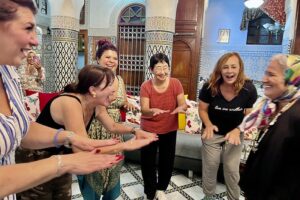
We intentionally keep our Morocco groups small — typically 5–12 travelers — to create a more intimate and connected experience.
This isn’t just about preference; it’s about access. The traditional riads we stay in have a limited number of rooms, and Morocco’s historic medinas are made up of narrow, winding alleyways — not roads designed for buses or large tour groups. Many big tour companies either skip places like Chefchaouen or only stop briefly because their groups are simply too large to comfortably stay overnight.
Traveling in a smaller group allows us to move easily through the medinas on foot, stay in locally owned riads, and enjoy experiences that larger tours simply can’t — including meals in family homes, where space is naturally limited.
Smaller groups also mean more meaningful cultural interaction, personalized attention from your host and local guides, and a genuine sense of community throughout the journey.
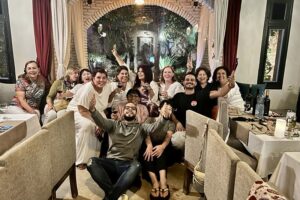
Our travelers are generally between their mid 30s and early 70s, with most joining us solo. They come from a wide range of professional and personal backgrounds, yet tend to share similar values: curiosity about the world, emotional intelligence, independence, and a desire for travel that feels both meaningful and well-designed.
We welcome men and women, LGBTQ, solos, and couples alike. What truly connects our groups isn’t age or background — it’s mindset.
The minimum age on our trips is 18.
To get a sense of the atmosphere and group dynamic, we invite you to browse photos from our previous journeys HERE.
Most daily experiences and excursions outlined in the itinerary are included in your trip cost, so you can relax and fully enjoy the journey without constantly reaching for your wallet.
That said, we intentionally built in free time throughout the trip. This gives you space to experience each destination in your own way — whether that’s booking a massage, browsing local markets, relaxing by the pool, or enjoying a long café stop.
If you’d like to arrange something additional during your free time, your host and local leaders are happy to offer recommendations and help point you in the right direction. Optional activities, spa treatments, personal shopping, and independent experiences are not included in the trip price and are at your own expense.
We believe the balance of curated experiences and personal time creates the perfect rhythm — guided when it matters, flexible when you want it.
Airport pick-up is not included in this trip. The arrival airport is Tangier (TNG), located approximately 10 miles (15 km) from your hotel in Tangier. The drive takes approximately 30 minutes, depending on traffic.
Upon arrival, you can take a taxi from the airport or pre-arrange a private transfer through a service such as Welcome Pickups
If you take a taxi, see our blog about getting from the Tangier airport to the city center for more details.
Airport drop-off is also not included. The departure airport is Marrakech (RAK), and your hotel can easily assist with arranging a taxi to the airport at the end of your trip.
Nationals of Australia, Canada, the United States, Ireland (EU), the United Kingdom, and New Zealand do not require a visa for stays in Morocco of up to 90 days. You may be asked to provide proof of onward or return travel, such as a departure flight ticket.
If you are not a citizen of one of the countries listed above, please check with your nearest Moroccan embassy or consulate for current visa requirements.
As a general guideline, your passport should be valid for at least six months beyond your planned departure date. Many countries will deny entry if a passport is set to expire within six months of the final day of travel.
The official currency of Morocco is the Moroccan dirham (MAD). The dirham is a closed currency, which means it cannot be bought or sold outside of Morocco. You will need to exchange money upon arrival in Morocco. Learn more about the currency in Morocco in our blog.
Australian and Canadian dollars are not commonly accepted for exchange. It’s best to bring Euros (EUR), US dollars (USD), or British pounds (GBP) to exchange locally.
Because the Moroccan dirham is a closed currency, you’ll need to wait until you arrive in Morocco to obtain local currency.
We recommend using ATMs while in Morocco, as they typically offer the most favorable exchange rates. The simplest option is to withdraw cash at the airport upon arrival and as needed throughout your trip. It’s also wise to carry a small amount of backup cash in case your bank places a temporary hold on your card.
Tip: If bringing foreign currency to exchange, make sure your bills are clean and in good condition, as damaged notes may not be accepted.
Credit and debit cards are accepted in Morocco’s larger cities, especially at higher-end hotels, restaurants, and shops. That said, outside the main cities, card payments aren’t as common. American Express and Discover are rarely accepted, so Visa and Mastercard are your safest bet.
For smaller shops, local restaurants, markets, and rural areas, it’s best to carry cash. Even if a place technically accepts cards, the machine may not always work.
Before you travel, be sure to notify your bank or credit card company that you’ll be using your card in Morocco. Some banks automatically block international transactions if they haven’t been alerted to your travel plans.
For more information about tipping your trip leader, please see our blog about tipping guides.
When it comes to spending money, every traveler is a little different. You know your own habits best, so please budget accordingly for optional meals, drinks, shopping, optional activities, laundry, and any personal extras. Be sure to review the itinerary and inclusions carefully so you’re clear on what’s already covered in your trip price and what you’ll pay for while traveling.
As a general guideline, we recommend having access to $500–$700 USD, either in cash or available on a credit/debit card. It’s always wise to budget a bit more than you think you’ll need, just in case of emergencies.
Since most major components of your trip are prepaid, your out-of-pocket expenses will mainly be:
Some lunches and dinners
Optional activities
Drinks and personal purchases
Morocco is also a fantastic place to shop — many past travelers say it’s their favorite country for unique finds, so pack light! You’ll encounter beautiful Berber rugs, argan oil, rosewater, pottery, leather goods, and more.
Higher-end shops and hotels typically accept credit cards, but markets and smaller vendors usually prefer cash.
Yes — as we explore Morocco’s medinas and traditional neighborhoods, we’ll visit a few local workshops and cooperatives (such as argan oil producers, ceramics, or leather). In some cases — like the tannery — you’ll pass through a shop on the way out. This is simply part of how things operate in Morocco and part of the overall experience.
There is absolutely no obligation to purchase anything.
If shopping or demonstrations (like argan oil) aren’t of interest to you, that’s completely fine. There’s usually a nearby café or spot to sit and relax while others browse. We’ll keep these stops reasonable and build in short breaks so those who want to buy something have the opportunity, without it taking over the day.
Yes — most reputable shops that sell larger items (such as rugs, lanterns, or ceramics) can arrange international shipping for an additional fee.
If you decide to ship something home, be sure to get a detailed receipt, confirm exactly what is being shipped, and ask for the shop’s WhatsApp number before you leave. If you need to follow up once you’re back home, communication will almost always happen via WhatsApp — vendors will not make international phone calls to the U.S. or other countries due to cost.
All purchases and shipping arrangements are made directly between you and the shop. While your trip leader can help with general questions at the time of purchase, we’re not able to assist with shipping issues or disputes after the trip.
When using your phone overseas, be sure to check with your provider to get informed about data and call roaming prices. When you land in Morocco, you will usually get a message from your provider that will give you the price of data, calls and texts in that country. See the example below:
Welcome to Morocco! Your plan gives you unlimited data at up to 2G speeds and texts at no extra cost. Calls at 20 cents/min. Want our fastest data and unlimited calls? Get an International Pass for just $5/day.
You may consider contacting your service provider to learn about what kind of international plans they offer for calls, texts and data.
While mobile phone coverage is generally good in Morocco’s cities and metropolitan areas, expect limited or even no coverage in remote or mountainous areas.
All hotels on your Morocco trip offer complimentary Wi-Fi, and many restaurants and cafés in larger towns and cities do as well. That said, internet speeds may be slower than what you’re used to, and connections can occasionally be unreliable.
In more remote areas — especially in rural regions and the Sahara Desert — Wi-Fi can be weak, spotty, or unavailable altogether. It’s best to be prepared to unplug and enjoy a little digital detox while you’re there.
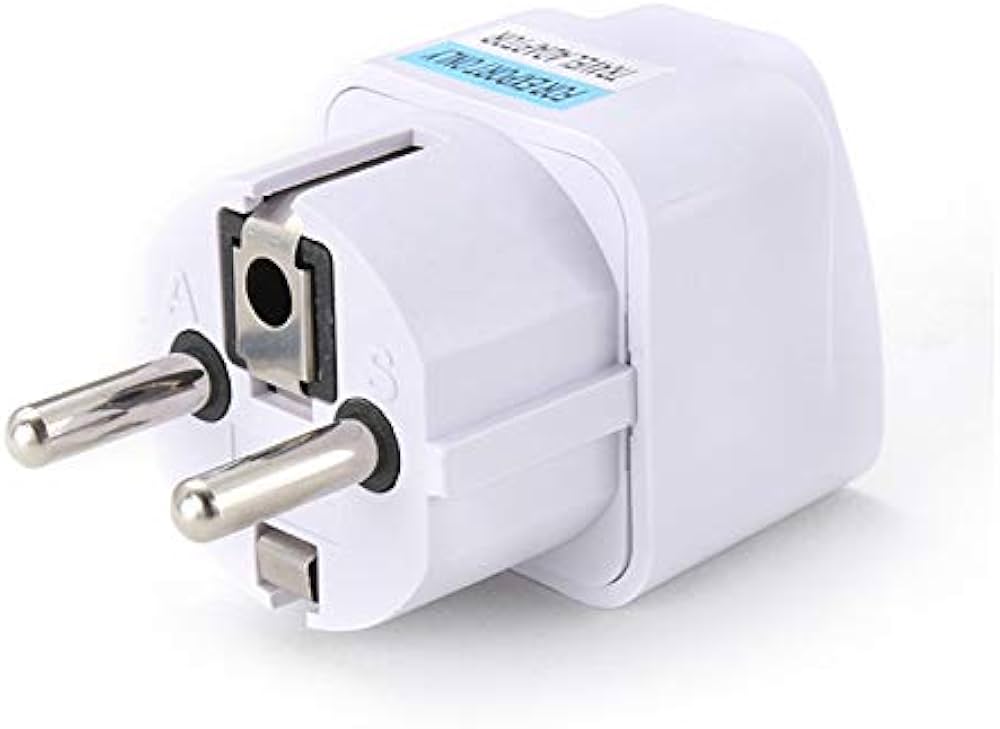
Morocco operates on a 220V supply voltage and 50Hz frequency.
The plugs used are primarily Type C and Type E, which have two round prongs (as shown above). If your devices use flat prongs (like in the U.S. or Canada), you will need a plug adapter.
During the day, most areas are warm to hot, especially in cities like Marrakech and Fes. Coastal towns tend to be a bit milder, while inland areas can feel quite warm under the sun. Evenings are typically cooler and comfortable.
In the Sahara Desert, daytime temperatures can be warm, but once the sun sets, it cools down quickly. Nights in the desert can feel quite chilly, so a warm jacket or sweater is essential, even in spring and fall.

Morocco’s weather varies by region — warm to hot during the day, cooler in the evenings, and cold at night in the Sahara and mountains. Even in spring and fall, desert temperatures drop quickly after sunset, so layers are essential.
Morocco is a Muslim-majority country, and while it’s very welcoming to visitors, dressing modestly is recommended out of respect for local culture and to avoid unwanted attention. Shorts and tank tops are not advised for men or women outside of beach/pool areas.
Below is a practical, well-rounded packing list to help you stay comfortable:
Recommended but not necessary
A Few Extra Notes
Almost all of the hotels we use do not have elevators, and many have up to three flights of narrow stairs. We also change hotels frequently (8 times during the trip), so luggage is moved often.
Please pack thoughtfully and avoid bringing very heavy suitcases (70 lbs / 32 kg). Large bags are difficult to maneuver through tight staircases and are a lot for hotel staff to carry. A medium-sized suitcase is much more manageable and will make the experience smoother for everyone.
Most of the hotels on this trip offer laundry services for a fee if needed. It is best to give laundry to the hotel staff as soon as you arrive.
Tap water in Morocco is not recommended for drinking, so we suggest sticking to bottled or filtered water.
Most hotels on this itinerary provide complimentary bottled drinking water in your room daily, and bottled water is inexpensive and widely available throughout Morocco.
What about ice?
Ice in restaurants, cafés, and hotels is generally made from filtered water and is perfectly safe — especially in cities and tourist areas. You can absolutely enjoy iced beverages throughout the trip without worry.
As always, when traveling, use common sense in very remote areas, but in normal restaurants and cafés, iced drinks are standard and safe.
Morocco is generally considered a safe country for travelers, with both violent and non-violent crime rates relatively low. The most common issue visitors encounter is petty crime, such as pickpocketing.
As with any destination, it’s important to stay aware of your surroundings and avoid leaving belongings unattended. Simple precautions go a long way in preventing problems.
We recommend:
Avoiding flashy or expensive-looking jewelry
Using a secure crossbody bag or daypack that zips fully closed
Keeping valuables out of back pockets
Being especially mindful in crowded areas
In larger cities such as Marrakech and Fes, pickpocketing is more common — particularly in the medinas and busy tourist spots. Thieves tend to target distracted visitors in crowded areas, so keeping your belongings secure and staying alert is key.
The US State Department offers general travel information about Morocco. See below for more information:
Food in Morocco is delicious but can be quite repetitive — especially outside the larger cities. You’ll see a lot of tagine, grilled meats, bread, and simple salads on menus, particularly in smaller towns and remote areas (which make up a good portion of this trip).
In bigger cities like Marrakech and Fes, you’ll find a wider variety of options, including French and Italian restaurants. We recommend taking advantage of those opportunities if you’re craving something different, as menu choices will become more limited once we head into more rural regions.
If you have dietary restrictions (gluten-free, vegetarian, vegan, allergies, etc.), please let us know at the time of booking. We will always do our best to accommodate you, but flexibility is important — particularly in the more remote parts of the itinerary where options can be limited.
For more information about vegan/vegetarian options and food in Morocco, feel free to check our blog about food in Morocco!
Please review the CDC Health Information for Travelers Website before traveling to Morocco to see any recommended vaccinations.
If you suffer from pre-existing medical conditions or are concerned about what vaccinations may be right for you, we strongly advise that you visit a medical professional or your personal physician before your trip.
We offer private trips to Morocco depending on the size of the group and availability.
Your arrival airport is Tangier (TNG) and your departure airport is Marrakech (RAK).
Please do not purchase flights until Globe Drifters confirms that your departure is guaranteed. After booking the tour, you will receive additional arrival and departure guidance by email.
Americans, Australians, Canadians, UK, New Zealand, and EU passport holders traveling to Morocco for fewer than 90 days do not require a visa for tourism.
You may be asked to show proof of onward or return travel (such as a departure ticket) upon arrival.
If you are not a citizen of one of the above-mentioned countries, please check with your nearest Moroccan embassy or consulate for information on visas.
Temperatures in Morocco vary by region and season, but you can generally expect warm to hot days and cooler evenings. Coastal cities tend to be milder, while inland and desert areas experience more extreme temperature swings.

In Morocco, we stay in handpicked, locally owned riads and boutique hotels — not large chain properties. We prioritize central locations, strong service, and authentic character.
Most hotels in Morocco do not serve alcohol. If you’d like an alcoholic beverage at the hotels we stay at, we recommend buying some at the duty-free. We’ll also stop at a grocery store at the beginning of the trip so you can pick up snacks for the longer bus rides and alcoholic beverages. We will be in the same bus for the duration of the trip.
Opened in 1930 by British aristocrat John Crichton-Stuart, the 4th Marquis of Bute, this historic Tangier hotel overlooks the Bay of Tangier and was once a glamorous playground for celebrities and politicians.
While its luxury has seen better days, it still carries the atmosphere of its heyday — with an Andalusian patio, traditional Moroccan details, and sweeping views that hint at the elegance it was once known for. It’s less about modern polish and more about stepping into a piece of Tangier’s storied past in one of the oldest hotels in the area still in operation.
There are 2 restaurants, plus a wine bar and a piano bar. Other amenities consist of an outdoor pool and a sundeck, as well as a health club offering a sauna, a hammam, and spa treatments.
This hotel is located inside Chefchaouen’s medina and is a convenient base to explore The Blue City. It also offers a rooftop terrace known for its sweeping views over the town and surrounding mountains. Guests can start their day with breakfast on the panoramic rooftop, while the restaurant serves international cuisine throughout the day.
This boutique accommodation is a former home of one of Fes’ most prominent merchant families. It is conveniently located within the walls of the ancient medina and boasts a restaurant serving local specialties, a rooftop bar, and a hammam. Nestled in the hotel’s courtyard, you’ll find a beautiful garden with a bubbling fountain. This hotel also prides itself on sourcing local staff as well as local or national products wherever possible. They also strive to reduce their carbon footprint by, for example, donating old bed linens to be made into reusable shopping bags for locals in need of them.
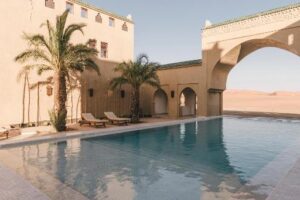
Located at the edge of the Sahara Desert, this oasis-style hotel offers a comfortable base for exploring the surrounding dunes. It combines modern amenities with a traditional desert setting, giving guests a relaxed and authentic experience.
The property features a swimming pool with panoramic desert views. There is free Wi-Fi throughout, an on-site restaurant, a lounge area, an outdoor fireplace, and a games room. Guest rooms are air-conditioned and include private balconies or terraces.
Activities such as Jeep excursions into the dunes and evening stargazing can be arranged, along with time to unwind and enjoy the desert.
The camp offers an unexpected level of comfort in the harsh Saharan Desert. You’ll have the nearly all same amenities as in a hotel room, including a comfy bed and private bathroom with a shower, toilet, sink, and hot water in the middle of Africa’s largest desert! There are space heaters in the tents if needed.
Outside the tents, there are lounges and coffee tables set up in the sand as well as a fireplace and a dining area.
NOTE: There is no air-conditioning in the tents but past travelers have not had any issues as the desert cools down significantly at night. There is spotty and slow Wifi in the restaurant area so be prepared to disconnect for your 1 night in the desert.
At the gateway to the desert and at the foothills of the High Atlas mountains, your hotel near Ouarzazate, stands in the heart of a Berber village on the route once taken by caravans from Timbuktu.
Nestled on the edge of the desert, this ancient kasbah restored as a boutique hotel blends into the landscape with its authentic architecture. The property offers a pool with views of the Atlas Mountains and palm groves, lush gardens, terraces, a bar, a restaurant serving fresh meals, and a spa with hammam and massages.
The spacious rooms feature private terraces, seating areas, and unique designs with salvaged furniture, Berber engravings, and traditional Moroccan tiles.
This 19th-century riad, located within the medina, blends Moroccan and Andalusian architecture. The property features a swimming pool, a rooftop terrace with city views, a hammam, and massage services. The on-site restaurant serves Moroccan and international cuisine while the lounge and bar provide inviting spaces to unwind.
*Accommodations are subject to change.
We recommend that you purchase trip/travel insurance for your trip. We work with Travelex which offers travel protection plans to help protect you and your travel investment against the unexpected. Travel protection plans include coverage for Trip Cancellation, Trip Interruption, Emergency Medical and Emergency Evacuation/Repatriation, Trip Delay, Baggage Delay, and more. Otherwise, you are welcome to shop around online for a provider and policy that best suits your needs.
For more information on the recommended plans or to enroll, click on the image below or contact Travelex Insurance Services at 800-228-9792. Globe Drifters’ reference location number is 09-0984.

The product descriptions provided here are only brief summaries. The full coverage terms and details, including limitations and exclusions, are contained in the insurance policy. Travelex CA Agency License #0D10209. All products listed are underwritten by, Berkshire Hathaway Specialty Insurance Company, NAIC #22276. 11.17 E7N
I enjoyed my time on this trip despite being the youngest (so 20 somethins, don’t be afraid to go). It really was a once in a lifetime type of experience. Morroco is a beautiful country with great food and an amazing culture plus history. Everyday there was something to do, which does get tiring after a while IF you are expecting to relax on vacation rather than explore/have an adventure. Keep that in mind. I had a rude awakening but got over it after a week LOL. There is a lot of on the go each day and lots of walking. You either love it or you don’t! I loved that I got to see many different cities in Morroco and not just one or two. Adil was our tour guide, along with some wonderful local your guides for certain smaller towns or specific activities. He is such a knowledgeable, fun person. Tips for the trip: 1. bring walking shoes. 2. This is a Muslim country so young travelers like myself, leave extra skimpy clothes at home you prob will feel weird wearing them outside of every city except Marrakech even if you’re brave enough to disregard the cultural norms. I had to buy some new clothes on the trip. 3. If you have important business/family calls to take, just purchase an international plan or pass from your phone provider before you leave your home country as the eSIM service and WiFi is NOT reliable inside of Riads and smaller/older towns (doing it before you leave your home country is really important). 4. Keep an open mind. 5. Take another week off from work or school to relax after the trip because you will not be relaxing on the trip, it’s an adventure! You will be exhausted by the time you get home. 6. Bring more money than you expect, and bring a Visa credit card. It’s hard to resist all the sellers in Morroco LOL. Try to bargain and make sure you don’t get carried away, there are some things you can buy when you get home that are the same price or probably cheaper from small businesses that get things directly from Morroco. So it’s not your only chance to get an authentic Morrocan item like a tea pot or tea glasses etc. They’re always trying to sell you something in Morroco. Don’t fall for it every time unless it’s really rare in your home country or you need it from Morroco specifically. For example, I wanted certain clothing and my Qu’ran for a loved one that studies Islam from a Muslim country specifically. Last, but not least 7.ENJOY YOURSELF! Take lots of pictures because this is a trip you never want to forget. It is unique and you will never find another destination as amazing as this one.
Adil our tour guide for Morocco trip 2025, he was incredible amazing.
He has a spark , he is an outgoing guy.
He care about everyone not matter what ,he makes you feel welcome to his country and makes everyone happy with his histories and wonderful mod.
To feel in a wonderful trip experience you need this guy Adil. He made a big difference .
this trip was absolute great and the desert wow incredible.
thank Adil for making this group unique and fun.
I love globe drifters. This is my 3rd trip with them.
It was a fantastic trip. Globe Drifters did a wonderful job, chose an amazing tour guide named Adil, who was knowledgeable, fun and energetic. The itinerary was well planned and allowed us to see the beautiful country side with cultural immersion, not just touristy areas. Great food, good people, small group. I would highly recommend this trip.
Morocco is a country that feels like stepping into a dream—a swirl of colors, sounds, spices, and centuries-old traditions that captivate the senses. My recent 12-day Globe Drifters adventure across this North African gem left me enchanted and eager to return. Thanks to Adil, we navigated the medina with ease, learning the stories behind the architecture, spices, and hidden gems we’d never have found on our own. Adil’s storytelling made every drive feel like a passage through time—he shared legends, historical context, and personal anecdotes that brought each stop to life. His ability to switch between languages—Arabic, Spanish, French, English, and Berber—was impressive and made communication seamless. Morocco is a feast for the senses, but it was Adil who turned our trip from wonderful to life-changing. If you’re considering a trip to this beautiful country, don’t hesitate. And if you’re lucky enough to have Adil as your guide, you’re in for something truly special.
If your thinking of traveling to Morocco book with Globe Drifters! This was by far the best tour I have taken. Amazing accommodations close to sights, small group tour, and delicious food wherever we were staying. Our tour guide Adil was the best and made the trip a wonderful experience. I will definitely be coming back to Morocco to visit and also take another tour with Globe Drifters!

Experience the magic of Portugal at your own pace on our slowcation… Explore Sintra’s fairytale castles, verdant hills, and charming…
BOOK NOW Details